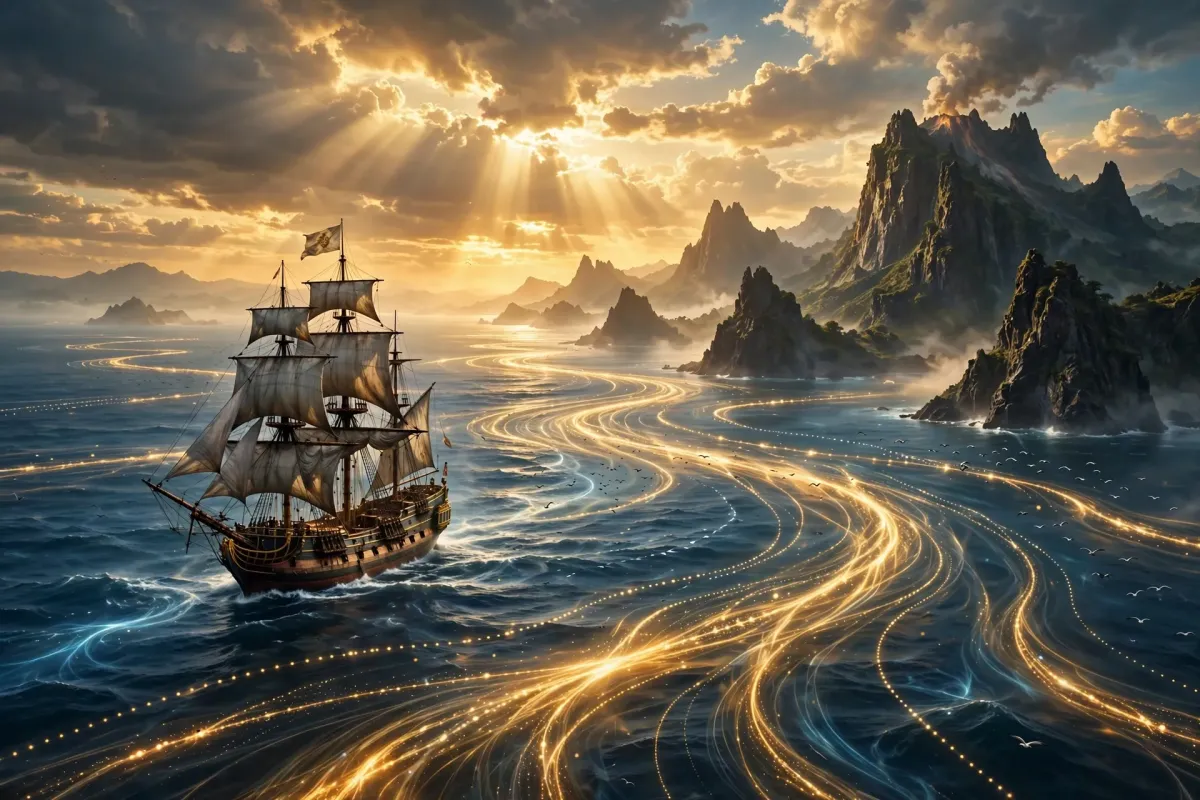
Echoes of Macaronesia (Part 4): The Maritime Nexus, Global Migrations, and the Eternal Atlantic Blueprint
As we move deeper into the hidden architecture of Macaronesia, we cross the threshold from ancient isolation into the vast, sweeping currents of global history. The Canary Islands were never just a remote cluster of volcanic peaks; they are the ultimate maritime nexus—a physical and energetic stepping stone connecting the Old World, Africa, and the Americas.
For the modern seeker and genealogist, understanding this final layer reveals how a localized island chain became the beating heart of transatlantic exploration and ancestral migration.
The Provisioning Capital of the Age of Discovery
When European explorers first looked westward across the unmapped Atlantic, the Canary Islands served as an indispensable lifeline.
The Last Safe Harbor: Long before crossing the open ocean, fleets required fresh water, timber, cured meats, and locally cultivated grains. Christopher Columbus famously anchored his westbound expeditions in the Canaries, recognizing that skipping this volcanic outpost meant risking starvation on the open sea.
Winds and Currents: Due to the reliable trade winds and ocean currents, the islands functioned as a natural conveyor belt. Ships departing from European ports naturally dropped down to the latitude of the Canaries before catching the steady push westward toward the Caribbean and the Americas.
The Transatlantic Diaspora: Planting Canarian Roots Abroad
The intersection of cultures on the islands did not stop with the European conquest; it radiated outward, carrying Canarian bloodlines, agriculture, and dialect across the globe.
Families of the Fleet: When the Spanish Crown established trade routes to the New World, Canarian families were frequently recruited to settle strategic colonial outposts, from the Caribbean islands to the Gulf Coast of North America (such as the historic founding families of San Antonio, Texas).
Cultural Fusion: The traditional music, speech patterns, and resilience of the Canarian people blended deeply with indigenous and African elements across the Americas, creating an enduring transatlantic cultural fingerprint that persists to this day.
The Volcanic Grid and the Modern Soulprint
When we tie all four chapters of our journey together—from the primordial volcanic origins and the North African Guanche roots, to the mother goddess myths, the medieval European crosscurrents, and the global maritime expansion—a clear picture emerges.
The Canary Islands are a masterclass in survival, adaptation, and memory. They remind us that history is not just a collection of dates, but a living grid of energy and lineage. When a landmass echoes in your spirit across centuries and miles, it is an invitation to trace your own inner compass back to the source.
When a landscape calls to you across time and space, it is rarely a coincidence—it is an invitation to reclaim a piece of your own forgotten history. The Canary Islands stand as a timeless monument to resilience, isolation, and sacred origin, proving that the deepest roots of human existence are etched not just into stone and soil, but into the eternal pulse of the ancestral grid.
Here is the CTA for the end of Part 4 that circles back to complete the loop, inviting readers to return to the beginning of the journey:
Ready to explore the roots of the journey from the beginning?
Loop back to where it all started with Echoes of Macaronesia (Part 1): The Ancestral Call, First Footprints, and the True Peoples of the Canary Islands, and trace the Atlantic grid right back to its source.