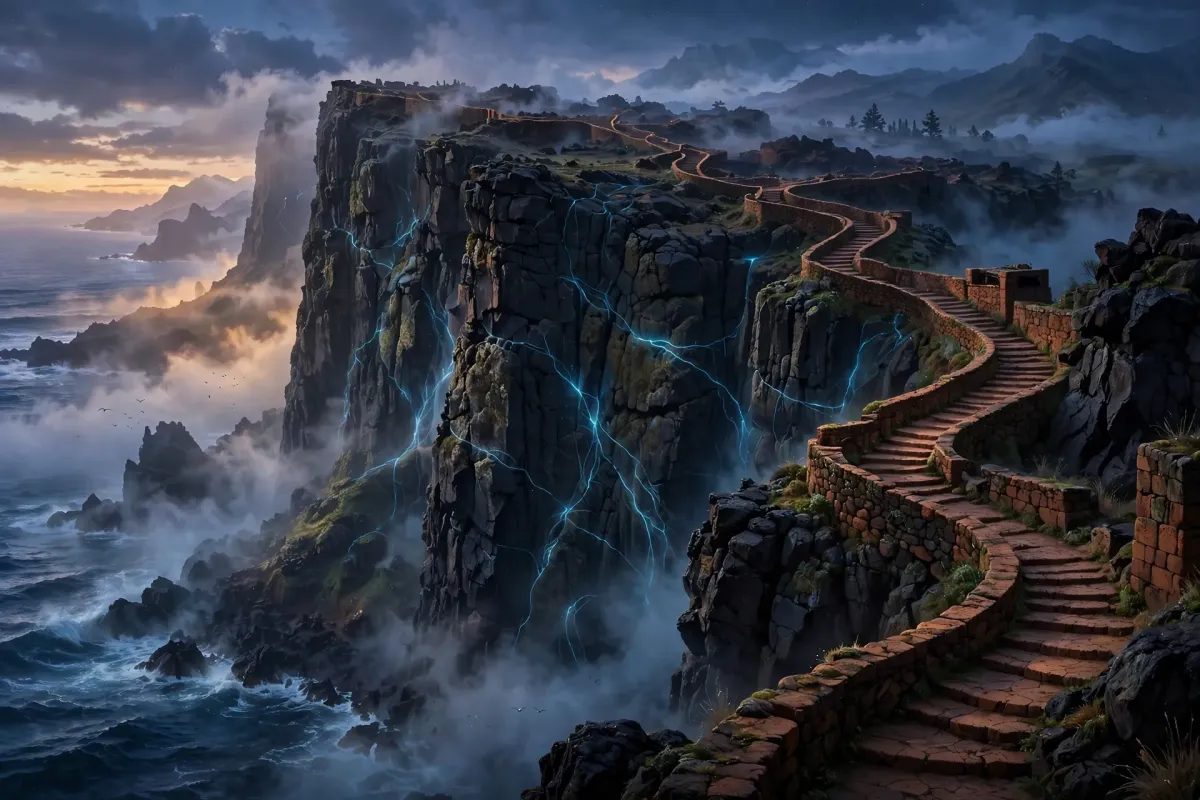
Echoes of Macaronesia (Part 1): The Ancestral Call, First Footprints, and the True Peoples of the Canary Islands
When we think of island paradises today, we picture resorts, white-sand beaches, and sun-seekers. But beneath the tourism veneer of the Canary Islands lies an ancient, deeply mysterious world that predates written European history by millennia.
When certain lands call to us—not just through history books, but through an inner, cellular resonance—it is often because our ancestors, spirit guides, and multidimensional lineages are pulling back the veil. The Canary Islands are a prime energetic anchor point: a volcanic threshold where the physical records of ancient North African civilizations meet the subtle whispers of forgotten timelines.
The Ancestral Call: Why Certain Lands Echo in the Blood
Why do specific geographic coordinates captivate our souls, even if we have never set foot there physically?
The Grid of Resonance: Earth is mapped by ley lines and ancient energy centers. Islands like the Canaries—isolated in the vast Atlantic—acted as natural time-capsules and spiritual waypoints for ancient seafaring cultures.
Cellular Remembering: When your guides or ancestors nudge you toward a specific landscape like Macaronesia, they are often pointing you toward an energetic key. The isolation, the volcanic ash, and the remnants of a culture cut off from the rest of the world for centuries create a powerful transmission field for anyone doing deep ancestral and soul print healing.
Who Was Here First? The Indigenous Roots
Popular culture often throws around the word "Guanche" to describe every pre-Hispanic inhabitant of the Canary Islands. Strictly speaking, however, the Guanches were specifically the indigenous people of Tenerife. Each of the seven main islands held its own distinct community, culture, and social layout.
The North African Migration: Historical and archaeological data—backed by modern paleogenomic studies—confirm that the earliest permanent settlers arrived from North Africa (tracing closely to ancient Amazigh/Berber populations) around the first centuries of the Common Era.
The Great Isolation: Once they crossed the brutal open Atlantic with their goats, sheep, and barley seeds, regular contact with the mainland ceased. Over centuries of absolute isolation, each island evolved into its own micro-society, developing separate dialects, customs, and political structures without the use of metals.
The Unique Ecosystem & Animals That Were There First
Long before humans ever set foot on the black volcanic shores, the Canary Islands served as a natural laboratory of incredible, isolated evolution.
Nearly one in three native wild species found here is endemic—meaning they exist nowhere else on Earth.
The Giant Fauna of the Past:
Before human arrival, the islands were home to prehistoric giants, including the Tenerife and Gran Canaria giant rats (Canariomys) and giant lizards (Gallotia) that ruled the rocky undergrowth.
The Winged Jewels:
The dense, humid laurisilva (laurel) forests—relics of the ancient subtropical forests that covered Europe millions of years ago—became the exclusive home to rare birds like the Bolle’s Pigeon, the Laurel Pigeon, and the famous Atlantic Canary (Serinus canaria), the wild ancestor of the domestic yellow singing bird.
The Blue Chaffinches:
High up in the volcanic pine forests live the striking Tenerife and Gran Canaria Blue Chaffinches, species finely tuned to the high-altitude volcanic canopy.
Society, Kings, and the Nine Kingdoms of Tenerife
On Tenerife, the society was organized into nine distinct territories called menceyatos, ruled by chieftains known as menceys.
Stone-Age Ingenuity:
Deprived of metal ores, the islanders mastered the volcanic elements. They shaped hard basalt into tools, bone into needles, and razor-sharp obsidian (volcanic glass) into fine cutting blades called tabonas.
The Gofio Tradition:
To survive the arid and vertical landscapes, they relied heavily on herds of goats and cultivated grains, roasting and grinding barley into a staple flour known as gofio—a nourishing staple food that remains a pillar of Canarian cuisine to this day.
The Mummification Mystery:
Much like ancient civilizations across the Mediterranean and Egypt, the Guanches practiced careful mummification of their dead, placing chieftains in hidden high-altitude caves to preserve them against time.
Surviving Footprints: Surnames and the Living Past
When the Spanish Crown completed its conquest of the islands at the end of the 15th century, the indigenous populations were largely assimilated, baptized, or displaced.
Yet they did not vanish; their genetic and cultural footprint remains woven into modern families.
The Indigenous Surnames:
Many modern Canarian surnames carry direct linguistic echoes of these pre-Hispanic roots, originating from indigenous place names, personal titles, or Hispanized versions of ancient Berber words (such as names featuring roots from Guanche royalty and regional descriptors like Oramas, Doramas, Bencomo, or Tacoronte).
Living Landscapes:
As you drive through the hairpin turns of the islands today, the names of the ancient territories—Adeje, Anaga, Icod, Daute, Güímar—remain carved into the very road signs and geography, outlasting the empires that tried to rewrite them.
When a landscape calls to you across time and space, it is rarely a coincidence—it is an invitation to reclaim a piece of your own forgotten history. The Canary Islands stand as a timeless monument to resilience, isolation, and sacred origin, proving that the deepest roots of human existence are etched not just into stone and soil, but into the eternal pulse of the ancestral grid.
Ready to uncover the unseen side of the archipelago?
Continue the journey with Echoes of Macaronesia (Part 2): The Lost Myths, Gods, and Mother Goddess Cults of the Canary Islands, where we pull back the veil on the sacred rituals, solar alignments, and ancient deities of the islands.