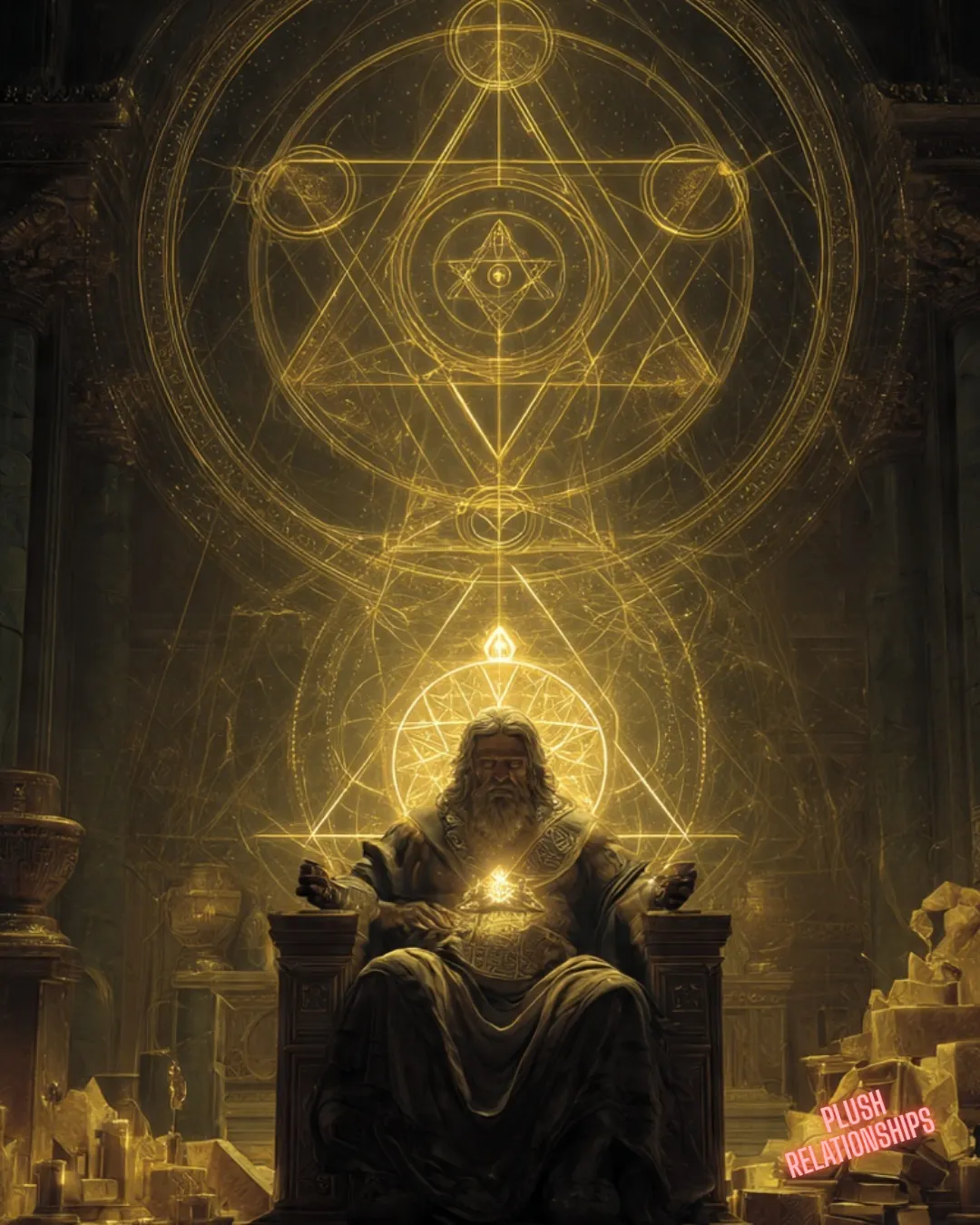
Wisdom, Wealth, and the Veil: The Multidimensional Legacy of King Solomon
Few figures in human history straddle the line between documented history and profound myth quite like King Solomon. To the historian, he was the master builder who turned ancient Israel into an economic superpower during the 10th century BCE. To the spiritual seeker, he is the ultimate archetype of divine wisdom, sacred geometry, and esoteric mastery.
Solomon’s legacy is a complex tapestry. He was a king who reached the absolute pinnacle of earthly power, only to conclude in his final days that it was all "vanity and vexation of spirit."
The Gift of a Discerning Heart
The defining narrative of Solomon’s life begins not with military conquest, but with a dream. According to biblical accounts, shortly after inheriting the throne from his father, King David, the Divine appeared to Solomon and offered him anything he desired.
Rather than asking for wealth, fame, or the destruction of his enemies, the young king made a singular request: an understanding heart to judge the people and discern between good and evil.
This request became the foundation of his legendary reputation. The most famous demonstration of this gift is the Judgment of Solomon, where two mothers claimed custody of a single infant. Solomon’s radical decree to cut the baby in half immediately exposed the true mother, who chose to surrender her child rather than see it harmed. It was a masterclass in human psychology—proving that true wisdom sees past outer arguments directly into the human heart.
The Architect of the Sacred
Solomon wasn't just a philosopher; he was a manifestation master. Utilizing the peace secured by his father's reign, he embarked on unprecedented architectural campaigns, the crown jewel of which was the First Temple of Jerusalem (Solomon's Temple).
The Blueprint of the Cosmos
According to esoteric traditions, the construction of Solomon's Temple was not merely an earthly building project. It was a physical manifestation of macrocosmic order—a structure built on exact mathematical alignments, hidden frequencies, and sacred geometry designed to bridge the physical world with the divine realm.
To build this massive spiritual center, Solomon formed a legendary alliance with King Hiram of Tyre, securing the finest cedars of Lebanon and master craftsmen. The temple became the physical anchor for a golden age of wealth. Trade routes flourished, gold poured into Jerusalem, and the fame of Israel's court spread so far that the enigmatic Queen of Sheba traveled across deserts just to test Solomon with hard riddles.
The Esoteric and Mystical Tradition
Beyond the orthodox historical texts lies a vast, sprawling ocean of mystical lore. In various esoteric traditions, folklore, and occult history, Solomon is revered as the ultimate magus.
He is credited with authoring foundational texts of wisdom literature, including Proverbs, Ecclesiastes, and the deeply symbolic, romantic allegory The Song of Solomon. In later grimoires and mystical texts, he is associated with the Seal of Solomon—a precursor to the Star of David featuring two interlocking triangles. This symbol represents the hermetic maxim "As above, so below," signifying the perfect union of the spirit and matter, the masculine and feminine, the divine blueprint and the earthly reality.
The Paradox of the Golden Age
Yet, the story of Solomon is also a cautionary tale of human limitation. The same king who possessed unparalleled wisdom eventually succumbed to the weight of his own vast empire. To secure political alliances, he took hundreds of foreign wives and concubines, eventually building altars to external deities and fracturing the spiritual purity he had fought to establish.
Upon his death, the heavy taxation and forced labor required to maintain his grand architectural projects caused the united kingdom of Israel to fracture into two rival factions, ending the golden era.
Solomon’s life leaves us with a profound paradox. He proves that while human intellect and wisdom can construct magnificent temples, accumulate unimaginable wealth, and decipher the deep mysteries of the universe, the human heart must remain anchored, balanced, and vigilant. He is an eternal reminder that the greatest architecture we will ever build is the alignment within our own souls.
How do you view King Solomon’s legacy? Is he a symbol of human potential and deep wisdom, or a reminder of how easily power can corrupt even the wisest minds? Let's discuss in the comments below!