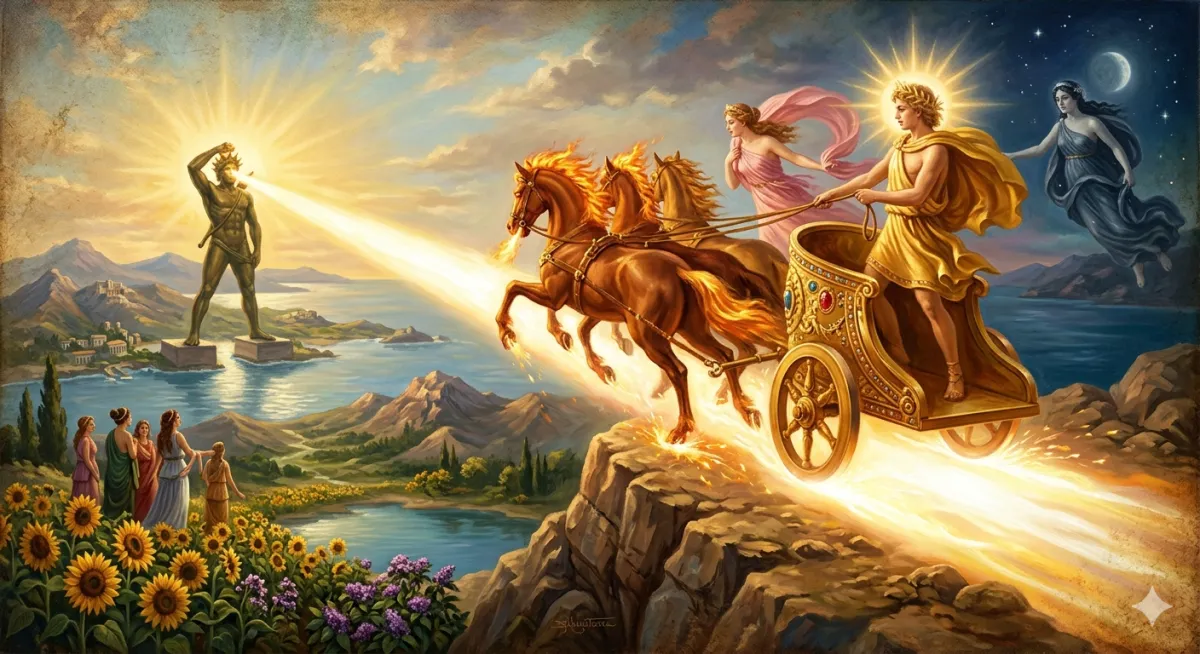
Helios: The Ultimate Guide to the Greek Titan and Sun God
In the vast tapestry of ancient Greek mythology, where power was constantly seized and redefined, few entities commanded a presence as literal, relentless, and essential as Helios. As the personification of the Sun, Helios was not simply a god who controlled a celestial body; he was the celestial body. He was the force that differentiated day from night, the witness to all earthly events, and the ultimate giver of life.
While the modern imagination often conflates the sun god with the Olympians, particularly Apollo, Helios represents an earlier, primordial era. He was a Titan, a remnant of the second generation of divine beings who ruled before Zeus established his throne on Mount Olympus. Helios’s story is a bridge, showing how the cosmos transitioned from raw cosmic power to structured divine law.
Lineage of Light: The Birth of the Solar Triad
To understand Helios is to understand the Titans, the children of the primordials Uranus (Sky) and Gaia (Earth). The Titans represented foundational, often intangible concepts of the universe. Helios is the son of two such beings:
Hyperion
The Titan of Light. His name literally translates to "he who goes above," signifying the movement of the heavens.
Theia
The Titaness of Sight and the "shining ether."
She is the divine force that makes vision possible, imbuing gold, silver, and gems with their sparkle.
From this potent combination of raw light and perception, Helios was born, completing a cosmic triad with his sisters:
Selene
The personification of the Moon, who drives her own silvery chariot across the night sky.
Eos
The personification of the Dawn, whose "rosy fingers" open the eastern gates to announce her brother’s arrival.
This sibling relationship is foundational. They are the celestial clockwork. Every morning, Eos initiates the cycle, Selene cedes the sky, and Helios assumes command. Unlike the later Olympian gods, who would often involve themselves in complex human politics and dramas, Helios’s existence was largely defined by his unwavering, absolute commitment to his celestial duty.
The Mechanics of the Heavens: Chariot, Horses, and the Cup
The central icon of Helios’s power is his golden chariot. To the ancient Greeks, this was the most logical explanation for how a ball of fire navigated the immense dome of the sky. This was not a passive journey; it required monumental divine strength and technical skill.
The Golden Chariot
The chariot itself was a masterpiece of divine engineering, forged by the smith god Hephaestus. In some accounts, it was built of burnished gold and jewels, designed specifically to reflect and focus the immense intensity of the sun’s light.
The Four Horses
The power source for this vessel was a team of four, immortal, fire-breathing stallions. Their names vary slightly in different classical sources, but they are most commonly known as Pyrios (Fire), Aeos (Dawn), Aethon (Burning), and Phlegon (Blazing). Their very breath was solar fire, requiring Helios to use divine gloves and reins just to hold them. Their task was to ascend a vertical path in the morning, cross the apex at noon, and then descend in a controlled manner toward the western horizon.
The Dayly Voyage and the All-Seeing Eye
Because Helios navigated the highest possible vantage point, nothing on the surface of the Earth could hide from his view. This earned him the essential epithet Panoptes, "The All-Seeing Witness." In ancient Greece, this made him a god of truth and oaths; many legal contracts and treaties were sworn under the light of the Sun, as it was believed Helios would witness any breach.
This all-seeing quality made him an instrumental figure in several significant myths:
The Abduction of Persephone
When Hades snatched Persephone, the goddess Demeter searched desperately. It was Helios who finally revealed the truth, having observed the entire event from his high chariot.
Ares and Aphrodite
When the god of war and the goddess of love met in secret, Helios observed their affair and immediately informed Aphrodite’s husband, Hephaestus, leading to the divine trap that caught them.
The Nightly Return: The Golden Cup of Oceanus
A critical but often overlooked detail of Helios’s journey is how he returned to the East. The Greeks believed the world was a flat disk surrounded by the primordial river Oceanus. After descending into the waters of the West, Helios would place his entire chariot and team into a massive, winged, golden cup or vessel. This vessel, also forged by Hephaestus, would float along the deep, northern currents of Oceanus, carrying him back to his eastern palace during the night, arriving just in time for Eos to begin the process again.
The Tragic Ambition of Phaethon: A Cosmic Crisis
The most famous narrative associated with Helios is the heartbreaking story of his son, Phaethon. This myth served as a moral warning and a complex origin story for terrestrial features.
Phaethon was Helios's son by the Oceanid nymph Clymene. Living on Earth as a mortal, Phaethon was often mocked by his peers, who claimed his mother was lying about his divine father. Determined to prove his parentage, Phaethon traveled eastward to the majestic palace of the Sun.
Helios, moved by his son’s determination and seeking to validate his claims, swore a "binding oath" by the River Styx—an unbreakable oath that not even a Titan could recant—to grant Phaethon any wish.
Phaethon’s request was catastrophic: he asked to drive the solar chariot for a single day.
Helios was devastated. He horizontal with grief, explaining to his son that the steeds were too powerful for even other gods to control, and that the physical path was too treacherous. He pleaded with Phaethon, offering him any other divine gift. But the oath was set, and the boy, fueled by pride and youthful ignorance, refused to yield.
The results were immediate. As soon as Phaethon took the golden reins, the horses recognized that the steady, crushing weight of their master’s hand was missing. They bolted. The chariot soared too high, freezing the constellations and endangering the heavens, then dove too low. The heat began to wither the Earth:
Creation of Deserts: Vast areas of green turned to sand, including the Sahara.
The Nile: The great river hid its head in the sand, explaining why its source was unknown.
The Ethiopian People: The intense heat scorched the population, darkening their skin permanently.
Zeus, observing the imminent total destruction of the world and the potential death of Earth herself (Gaia), was forced to act. To save existence, he struck the chariot with a single thunderbolt, destroying the vessel. Phaethon fell like a shooting star into the river Eridanus. His sisters, the Heliades, so consumed by grief at his death, transformed into amber-weeping poplar trees along the river's bank.
Helios was so paralyzed by sorrow that he refused to resume his duty. He plunged the world into an immediate, profound eclipse, refusing to light the heavens until the Olympian gods, led by Zeus and Apollo, pleaded with him to return to his post.
The Divine Bachelor? Consorts, Children, and Legacy
Helios is often perceived as a solitary figure, dedicated entirely to his duty, but this is incomplete. While he lacked a "wife" in the modern sense (like Hera was to Zeus), he maintained several significant partnerships, leading to a unique, often powerful, and occasionally terrifying lineage. His choice of consorts was strategic, usually with other powerful nymphs and primal beings.
The Magical Lineage of Perse (Perseis)
Helios’s most prominent and important partner was the Oceanid nymph Perse (or Perseis). She was another daughter of Oceanus and Tethys. Their union is pivotal because it generated some of the most powerful and dangerous sorcerers and magic-users in all of Greek mythology:
Circe
Perhaps the most famous of his children. She was the divine sorceress and goddess of magic who inhabited the island of Aiaia. In the Odyssey, she notoriously transformed Odysseus’s crew into swine. Her power was unique; she wielded pharmacopeia (potion magic) and commanded base creatures.
Aeetes
The powerful King of Colchis, in the far east. He was the guardian of the Golden Fleece and the father of the potent witch Medea. Aeetes himself was formidable, often possessing magical artifacts and knowledge directly from his father.
Pasiphae
The Queen of Crete and wife of King Minos. Although a goddess, she was cursed with a monstrous passion for the Cretan Bull, leading to the birth of the Minotaur. This lineage directly connects the Sun to one of Greek myth’s darkest stories.
The Children of Rhodes and the Heliadae
Helios’s relationships were sometimes origin myths for whole communities. When the Olympian gods divided the world, Helios was absent and was left with no island of his own. Zeus offered to redistribute the lots, but Helios refused. Instead, he chose a new, emerging island rising from the sea. This island became his, and he named it Rhodes after his beloved consort, the nymph Rhodos (a daughter of Poseidon or Aphrodite).
Their children, the seven Heliadae, were renowned across the ancient world:
They were said to be the first great astronomers.
They established the first civil laws for Rhodes.
One of them, Actis, was said to have taught astrology to the Egyptians.
Unrequited Love and the Sacred Flower
Not all of Helios’s relationships were fruitful. The Oceanid nymph Clytie was deeply in love with him, but his attention turned instead to a mortal woman. Overcome by jealousy, Clytie revealed the affair to the woman’s father. Helios, enraged by the nymph’s petty cruelty, abandoned her. Clytie sat on the cold ground for nine days without food or water, staring at her former lover as he crossed the sky. Her form slowly withering, she was transformed into the first heliotrope or sunflower. To this day, these flowers maintain her eternal posture, turning their heads to follow the sun’s daily journey.
The Sacred Spaces of the Sun: Sacred Cattle and Oaths
Helios's importance was integrated into the physical landscape and economy of ancient Greece:
The Cattle of the Sun (Thrinacia)
In the Odyssey, Helios kept seven herds of beautiful, immortal, white cattle on the island of Thrinacia. Each herd contained 50 head, perfectly totaling 350—the number of days and nights in the ancient lunar year. They were tended by his daughters. When Odysseus’s starving crew disregarded a divine warning and slaughtered some of the cattle, Helios was so furious that he threatened Zeus, saying he would take the Sun down to the Underworld and shine among the dead. Fearing cosmic collapse, Zeus promised justice and destroyed Odysseus’s ship with a storm, killing all but the captain.
The Colossus of Rhodes
The most famous architectural tribute to Helios was the giant bronze statue built on Rhodes to celebrate their survival of a massive siege in 305 BC. Standing an estimated 108 feet tall, it was one of the Seven Wonders of the Ancient World. Though it stood for only 54 years before being toppled by an earthquake, its scale remains iconic.
Sol: The Roman Counterpart and the Unconquered Sun
As Roman culture integrated Greek belief systems, Helios was synthesized with the Roman god Sol. However, "Sol" underwent a religious and political evolution that was far more potent than the Greek Helios.
Sol Indiges
This was the original, early Roman sun god, likely an agricultural deity. His worship was significant but not central to the state religion.
Sol Invictus (The Unconquered Sun)
This is the crucial Roman innovation. In the 3rd century AD, particularly under the Emperor Aurelian, the cult of Sol Invictus was elevated to the status of primary state religion. Soldiers were especially dedicated to him, viewing the Sun as an invincible, constant force.
December 25th
The central festival for Sol Invictus, Dies Natalis Solis Invicti (The Birthday of the Unconquered Sun), was celebrated just after the winter solstice. This date was chosen specifically because it was the moment when the days began to lengthen, representing the "victory" of the Sun over the darkness. The selection of this specific date for the celebration of Christmas by early Christians was a deliberate political and theological strategy to absorb and reorient the power of this vital state holiday.
The Confusion of Apollo
It is essential to address the common mistake of identifying the sun god primarily as Apollo. This confusion is late and largely Roman.
Greek Helios
The physical Sun itself and the dedicated charioteer.
Greek Apollo
The god of light, music, logic, archery, and prophecy. While he is a god of light, he does not physically steer the cosmic body in early lore.
Late Hellenistic and Roman Sol/Apollo
As early Greek thought progressed, philosophical concepts merged. Apollo became more "solar," and the Romans often combined them. In Roman epic poetry, such as Ovid’s Metamorphoses, the character who gives the chariot to Phaethon is frequently referred to as "Phoebus" (a title of Apollo) and the Sun interchangeably.
Enduring Legacy and Scientific Thought
Helios represents an essential step in how humanity understands the universe. He is a personification of raw, observed power. He is the first explanation for the consistency of the day, the change of seasons, and the mystery of creation and drought.
In Platonic philosophy, the Sun serves as the ultimate metaphor for the "Form of the Good." Just as the Sun illuminates physical objects, making them visible to the eye, the "Good" makes intellectual concepts visible to the mind or soul. This philosophical significance ensures that Helios’s legacy extends beyond mythology into epistemology.
In the end, Helios is a testament to consistency and dedication. While the Olympian gods were fickle, governed by lust and rage, the Titan of the Sun was constant. His enduring power is reflected in how often the ancient world saw his hand in truth, in agriculture, and in the rise and fall of empires.