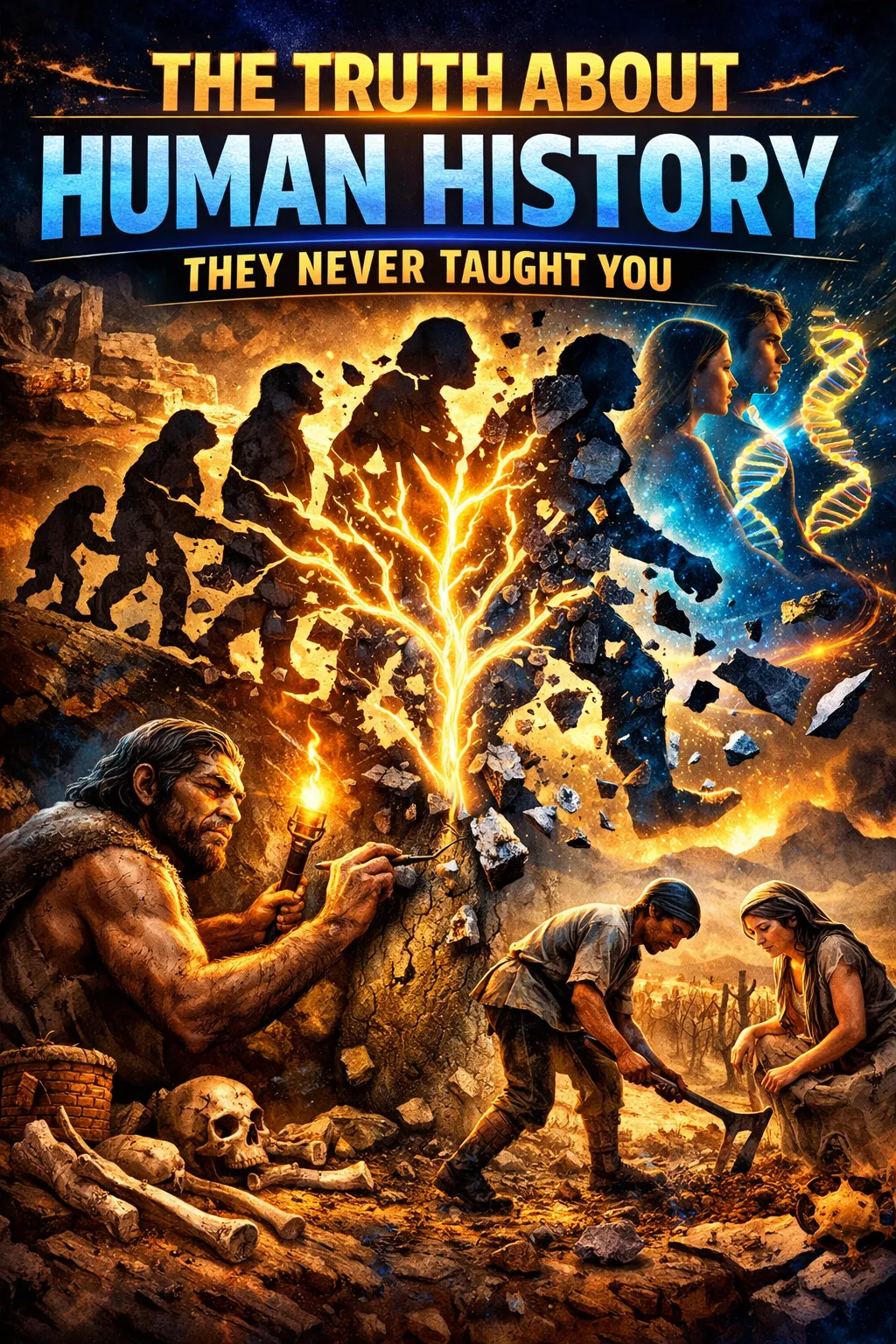
They Lied to You About Human History
When we look closely at the mainstream history of human development, we find a series of outdated assumptions, oversimplifications, and outright myths that have been taught in classrooms for generations.
Science doesn't stand still, and recent breakthroughs in genetics, archaeology, and anthropology have completely shattered several major narratives. It is time to debunk the theories they’ve tried to get us to believe and look at what the data actually says.
Myth 1: "The Linear March of Progress"
(The Ape-to-Man Line)
The Theory They Sold You
We have all seen the famous illustration The March of Progress, where a primitive, slouching ape transitions step-by-step into a straight-backed modern human. It teaches us to believe that evolution is a linear, deliberate ladder climbing toward a "perfected" species (Homo sapiens).
The Reality Check
Evolution does not work in a straight line, and it has no end goal. Human history is not a ladder; it is a messy, wildly tangled bush.
For hundreds of thousands of years, multiple highly intelligent, completely different human species coexisted simultaneously. Homo sapiens were not the inevitable "pinnacle" of evolution. We were simply one branch among many—including Neanderthals, Denisovans, Homo floresiensis, and Homo naledi—that managed to survive a series of brutal, erratic climate bottlenecks. We didn't evolve out of them in a neat line; we outlasted them, and in many cases, we cross-bred with them.
Myth 2: "Neanderthals Were Dumb, Brutish Cavemen"
The Theory They Sold You
For over a century, pop culture and early anthropology textbooks portrayed Neanderthals as dim-witted, grunting, hairy beasts who lacked language, culture, and intellect—ultimately going extinct because modern humans were vastly smarter.
The Reality Check
This narrative was rooted more in Victorian cultural bias than in actual science. Modern archaeological excavations have completely overturned this stereotype.
We now know that Neanderthals:
Practiced Deep Culture: They buried their dead with intentional grave goods and flowers, showing a capacity for abstract thought and grief.
Created Advanced Art: They painted intricate geometric art on cave walls in Europe long before Homo sapiens arrived.
Mastered Technology: They engineered a complex synthetic glue called birch bark tar using a sophisticated, multi-step heating process that requires precise temperature control.
Possessed the Capacity for Speech: Genetic mapping shows Neanderthals shared the exact same FOXP2 gene variant associated with speech and language development as modern humans.
They didn't disappear because they were stupid; their populations were simply smaller and more isolated, meaning they were eventually genetically absorbed into the massive waves of migrating Homo sapiens.
Myth 3: "The Agricultural Revolution Was a Giant Leap Forward for Human Well-Being"
The Theory They Sold You
The traditional historical narrative claims that when humans abandoned the chaotic, dangerous life of hunting and gathering around 10,000 years ago to settle down, farm, and build cities, our quality of life, health, and leisure time instantly skyrocketed.
The Reality Check
In many ways, the transition to agriculture was a biological trap for the individual human being. Anthropological studies of ancient skeletons reveal a startling truth: the earliest farmers were significantly less healthy than their hunter-gatherer ancestors.
When humans shifted to intensive farming:
Stature and Bone Health Shrank: The average height of humans plummeted, and skeletons from early agricultural eras show massive spikes in nutritional deficiencies, such as iron-deficiency anemia (cribra orbitalia).
Disease Exploded: Crowding people into permanent settlements alongside domesticated animals created the perfect breeding ground for zoonotic diseases—leading to smallpox, measles, and the flu.
The Diet Collapsed: Hunter-gatherers ate an incredibly diverse diet of hundreds of wild plants, nuts, and meats. Farmers relied heavily on a single, fragile crop (like wheat, corn, or rice), leaving them highly vulnerable to famine and malnutrition.
While agriculture allowed human populations to explode and civilizations to form, it initially made the daily life of the average human much more laborious, disease-ridden, and physically grueling.
Myth 4: "Human Evolution Stopped Thousands of Years Ago"
The Theory They Sold You
A surprising number of people believe that once humans built modern societies, sheltered themselves from the elements, and developed medicine, natural selection stopped applying to us. The theory goes that our biological evolution froze in place roughly 10,000 to 40,000 years ago.
The Reality Check
Human evolution didn't stop; in fact, evidence suggests it has actually accelerated over the past 10,000 years as our environments changed faster than ever before.
We are actively adapting to our own cultural and technological shifts right now:
Lactose Tolerance: Historically, adult humans could not digest milk. But when certain European and African cultures domesticated cattle thousands of years ago, a rapid genetic mutation spread, allowing adults to retain the lactase enzyme. This is a clear, incredibly recent evolutionary mutation driven entirely by culture.
Malaria Resistance: In regions of the world plagued by malaria, a genetic mutation causing sickle cell trait evolved rapidly because it provides a distinct survival advantage against the parasite, despite its health trade-offs.
High-Altitude Adaptation: Populations living on the Tibetan Plateau developed unique genetic variations in the EPAS1 gene (inherited from ancient Denisovan interbreeding) within just the last few thousand years, allowing their blood to process oxygen efficiently without thickening.
The Takeaway: Rewriting the Matrix
The old theories tried to make us believe that human history is a simple, predictable story of steady, upward improvement. But the real data shows something far more complex: a story of resilient survivors navigating chaos, absorbing sibling species, adapting on the fly to self-inflicted challenges, and actively rewriting their own biological blueprints.
By questioning the rigid frameworks we were handed, we can see humanity for what it truly is: an open-ended, deeply adaptable project that is still actively evolving today.