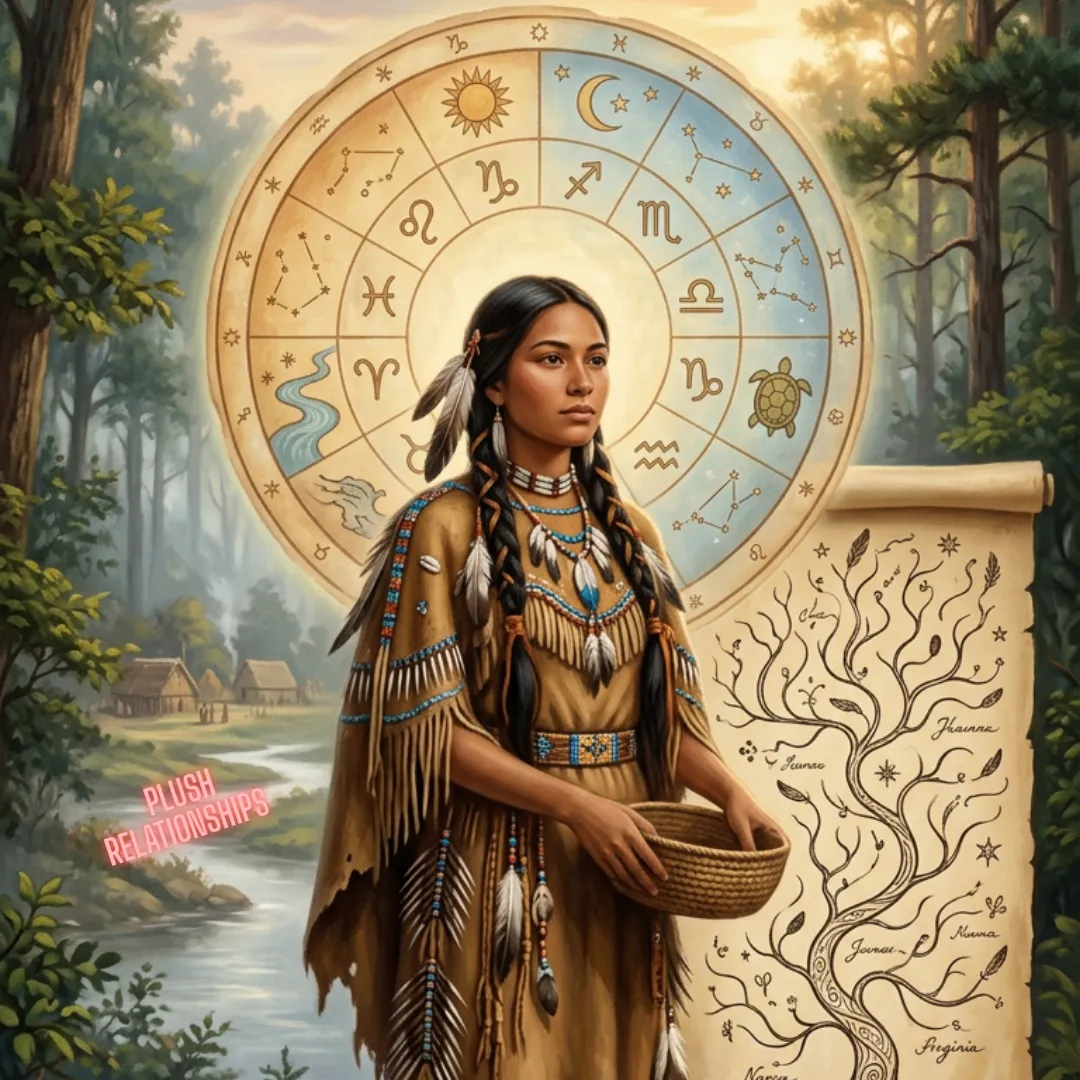
Beyond the Legend: The True Story of Matoaka (Pocahontas)
The story of Pocahontas is one of the most enduring myths in American history. From classic literature to modern cinema, we are often presented with a romanticized tale of a Native American "princess" who saved a brave English captain and lived a life of cross-cultural harmony.
However, the real story—etched in the oral traditions of the Mattaponi and supported by critical historical analysis—is far more complex, tragic, and significant than any movie could depict. To understand the real meaning of her life, we must look past the Disneyfied version and into the world of Matoaka.
What’s in a Name? Matoaka, Amonute, and the "Playful One"
The woman we know as "Pocahontas" actually carried several names, each reflecting a different layer of her identity within the Powhatan (Tsenacommacah) society.
Amonute: Her public name.
Matoaka: Her private, sacred name, used only within her tribe.
Pocahontas: This was actually a nickname given by her father, Paramount Chief Wahunsenacawh (Powhatan), meaning "the naughty one" or "playful child."
By only calling her Pocahontas, history has reduced a complex woman to a childhood nickname, effectively stripping away her status and spiritual identity.
The Myth of the "Rescue": Did She Really Save John Smith?
The most famous scene in American folklore—Pocahontas throwing herself over Captain John Smith to save him from execution—is almost certainly a fabrication.
The Problem with the Timeline
When John Smith arrived in 1607, Matoaka was only 10 or 11 years old. It is highly unlikely that a child would have been permitted to participate in, let alone interrupt, a high-stakes political or religious ritual.
Smith’s Changing Story
Crucially, Smith didn't mention this "rescue" in his early accounts of the trip. It wasn't until 1624—after Pocahontas had died and could no longer refute his claims—that he published the dramatic version of the story. Historians believe if any such event happened, it was likely a symbolic adoption ritual where Matoaka played a scripted role, not a life-or-death defiance of her father.
The Real Marriage: Kocoum vs. John Rolfe
Contrary to the "love story" between her and John Smith, they were never romantically involved. Matoaka’s first marriage was actually to a Powhatan warrior named Kocoum around 1610.
According to Mattaponi oral history:
Matoaka and Kocoum had a child together.
In 1613, Matoaka was kidnapped by Captain Samuel Argall.
During the abduction, Kocoum was allegedly murdered, and Matoaka was forced to leave her first child behind.
The later marriage to John Rolfe was not a romance in the modern sense; it was a political maneuver. While held captive, she was pressured to convert to Christianity, baptized as Rebecca, and married to Rolfe to solidify a "Peace of Pocahontas" between the English and the Powhatan.
Ambassador and Symbol: The Trip to England
In 1616, the Virginia Company brought Matoaka (now Rebecca Rolfe) to London. She was used as a propaganda tool to show the English Crown that "savages" could be "civilized" and converted.
The "Princess" Narrative: The English marketed her as an Indian Princess to gain favor and funding for the colony.
The Meeting with Smith: When she finally saw John Smith in London, she was reportedly furious, berating him for his betrayal of her father and his deceptive behavior in Virginia.
Tragically, as she prepared to return home in 1617, she fell gravely ill (likely from tuberculosis or pneumonia). She died in Gravesend, England, at the age of 21, never seeing her homeland again.
The Real Meaning: A Legacy of Survival
Matoaka’s life is a testament to the survival and resilience of Indigenous people. She was a diplomat who used her position to try and bridge two worlds that were violently colliding.
Today, her descendants and the Mattaponi tribe continue to tell her true story—not as a romantic sidekick to European expansion, but as a victim of colonial politics and a symbol of the enduring Powhatan spirit.
Tracing the Bloodline: The Genealogical Impact
For researchers diving into their GEDCOM files, Matoaka represents one of the most sought-after "gateway ancestors" in American genealogy. Her only surviving child, Thomas Rolfe, returned to Virginia as an adult, and his descendants—often referred to as the "Red Rolfes"—married into many of the "First Families of Virginia" (FFVs).
Comparing the History to Your GEDCOM
If you find Matoaka or her son Thomas in your family tree, you are part of a lineage that includes First Ladies (Edith Wilson and Nancy Reagan), explorers, and thousands of Americans.
The Gateway Link: Most connections go through Thomas Rolfe's daughter, Jane Rolfe, who married Robert Bolling.
The Missing Branch: While the "Red Rolfes" (descendants of Jane Rolfe and Robert Bolling) are well-documented, Mattaponi oral tradition maintains that Matoaka’s first child with Kocoum also left descendants. These lines were often "hidden" to protect the family from colonial displacement, making them a holy grail for genealogical researchers focusing on Indigenous roots.
Finding her in your records isn't just about a name; it’s about a direct biological connection to the very first interactions between the Old World and the New.
The Mattaponi Oral Tradition: The Sacred Truth
While Western history relies on John Smith’s journals, the Mattaponi tribe has maintained an oral history for four centuries that paints a much darker picture of Matoaka's captivity.
The Sacred Secret: According to the tribe, Matoaka was a priestess and a favorite of her father because of her sharp mind. Her kidnapping was seen as a spiritual blow to the Powhatan people.
The Forced Conversion: The Mattaponi maintain that her conversion to Christianity was under extreme duress—a "stockholm syndrome" of the 17th century—rather than a willing spiritual journey.
The Return of her Bones: For years, there have been movements to repatriate her remains from Gravesend back to her ancestral home in Virginia, a move that would symbolize the final "breaking of the ice" between her spirit and her land.
The Soul Blueprint of Matoaka
In the realm of spiritual archetypes, Matoaka represents the Bridge-Builder and the Sacrificial Sovereign. Her life was defined by heavy Plutonian themes—kidnapping, forced transformation, and a total rebirth.
When we look at her astrological and soul blueprint, we see a figure whose presence is so profound that it often ripples through the charts of those she is connected to. It is not uncommon for those carrying her lineage to find her signature appearing in their own astrological maps or soul blueprints.
Finding her in a chart is a call to ancestral healing. It signifies a connection to the "Root of America"—a soul task to bridge the gaps between cultures, to tell the truths that were silenced, and to transmute the trauma of the past into the sovereignty of the future. She is a prophetic messenger whose move to England was a mission to plant the "seed" of the Indigenous spirit in the heart of the empire.
Sources and References
To ground this article in historical and oral truth, we look to the following primary and secondary sources:
"The True Story of Pocahontas: The Historical Mattaponi Tribe" by Dr. Linwood "Little Bear" Custalow and Angela L. Daniel.
"The Generall Historie of Virginia" by John Smith (1624).
"Pocahontas and the Powhatan Dilemma" by Camilla Townsend.
The Records of the Virginia Company of London.
The Bolling Memoirs – Primary genealogical source for the Bolling/Rolfe lineage.
Honoring the Woman, Not the Myth
In 2026, as we work to heal our ancestral lineages and understand our own "Soul Blueprints," the story of Matoaka offers a profound lesson. She was not a fairy tale; she was a mother, a wife, a diplomat, and a survivor.
By acknowledging the real Matoaka, we honor the truth of the land. Whether she is a name in your GEDCOM, a presence in your chart, or a figure in your spiritual studies, her legacy is a call to look past the "ice wall" of history and find the human truth on the other side.