The Echo of a Broken String: The Tragic Radiance of Judee Sill
The history of music is often written in the margins by those who were too bright for the world they inhabited. We speak often of the "27 Club"—the Joplins, the Hendrixes, the Winehouses—whose flames were extinguished at the height of their commercial powers. But there is a quieter, perhaps more profound tragedy found in the life of Judee Sill, a woman of ethereal beauty and terrifying genius, who slipped through the cracks of the 1970s folk scene and left us long before the world learned how to listen to her.
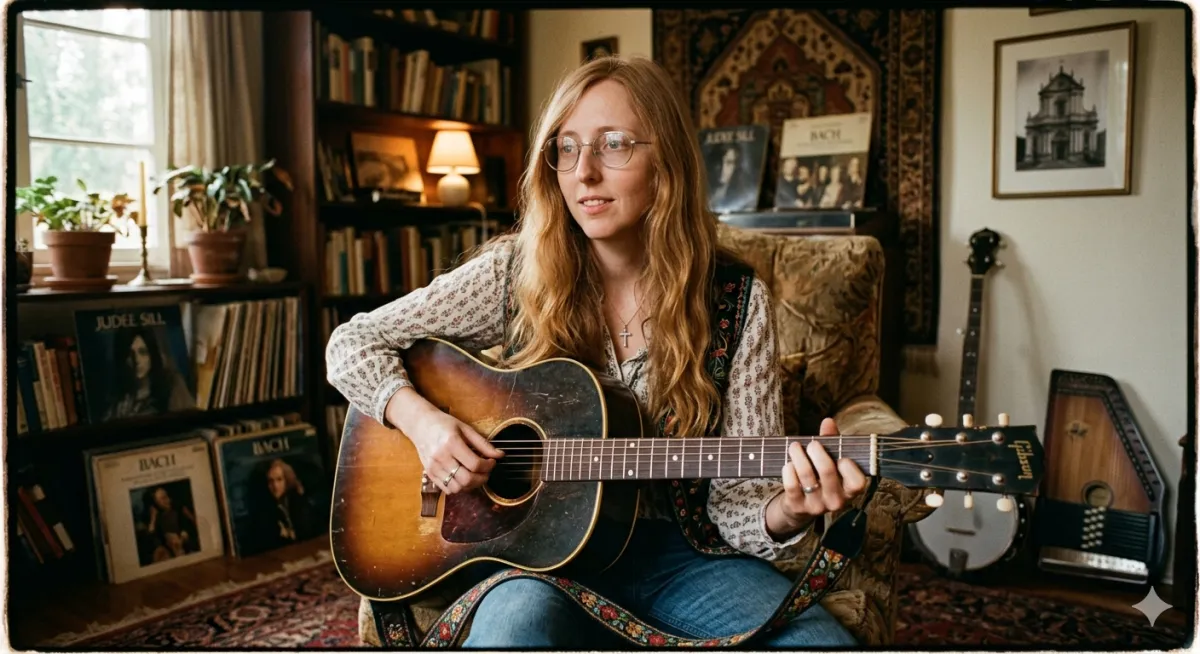
Judee Sill was not just a musician; she was a mathematical mystic who tried to bridge the gap between the gutter and the divine. With her waist-length golden hair, wire-rimmed glasses, and a face that possessed the stoic grace of a Renaissance painting, she looked like a quintessential Laurel Canyon folkie. But beneath the denim and the sunshine lay a soul haunted by "cosmic blues" and a musical mind that operated on the level of Johann Sebastian Bach.
The Architecture of a Lost Soul
To understand why Judee’s departure was such a profound loss, one must understand the sheer impossibility of her music. In an era of three-chord protest songs and breezy pop, Judee was composing what she called "Country-Cult-Baroque."
She didn't just strum a guitar; she orchestrated complex, multi-layered hymns. Her debut self-titled album (1971) and its successor, Heart Food (1973), are architectural wonders. She wrote every instrumental part herself, obsessed over the "overtones" of the universe, and sought to create music that could literally induce a state of grace in the listener.
"I'm trying to reach people, but I'm also trying to reach God," she once said. "And sometimes I think God is the harder sell."
Her songs, like the breathtaking "The Kiss" or the outlaw-gospel "Jesus Was a Cross Maker," weren't just melodies; they were desperate prayers. She used C major not just as a chord, but as a pillar of light. Her technical proficiency was staggering, yet she delivered it with a voice that sounded like a weary angel—pure, vibrato-less, and deeply lonely.
A Life Lived in the Shadows
Judee’s beauty and talent were frequently at odds with a life defined by trauma. Born in Oakland and raised in the grit of Southern California, her early years were a Dickensian blur of rebellion. By the time she was a teenager, she was a getaway driver for armed robberies and a frequent resident of reform schools.
It was in these institutions that she learned to play the organ, discovering that music was the only thing capable of quieting the chaos in her head. However, the shadows followed her. A heroin addiction took root early, leading to a cycle of prostitution and forgery to fund her habit.
When she was eventually discovered by Graham Nash and signed as the first artist to David Geffen’s Asylum Records, it seemed the "beautiful loser" had finally found her throne. But the music industry of the 1970s was a shark tank, and Judee—with her prickly brilliance and refusal to play the "pretty girl" archetype—didn't fit the mold.
The Silent Departure
The tragedy of Judee Sill isn't just that she died, but that she disappeared before she did. After her second album failed to find a massive audience, she felt betrayed by the industry and the "cosmic forces" she worshipped.
A series of devastating car accidents left her with chronic, agonizing back pain. In the mid-70s, before the era of modern pain management, she returned to the only thing that had ever numbed the sting: heroin. She vanished from the Hollywood hills, retreating into a world of occult studies and addiction.
When she passed away from a drug overdose in 1979, she was so far removed from the public eye that no obituary ran in the Los Angeles Times. One of the greatest composers of her generation died in a small apartment in North Hollywood, and the world simply kept spinning.
The Resurrection of a Legacy
For decades, Judee Sill was a footnote, a "cult artist" whispered about by record collectors. But beauty this potent cannot stay buried. In the early 2000s, a new generation of musicians—from Fleet Foxes to Weyes Blood—began citing her as a primary influence.
They saw in her what the 1970s missed:
The Unflinching Honesty: She didn't hide her "demons"; she invited them to tea and wrote fugues about them.
The Genderless Genius: She rejected the "female singer-songwriter" label, demanding to be seen as a composer on par with the greats.
The Sonic Purity: In a digital age, her analog, meticulously crafted arrangements feel like a lost religious text.
Why She Matters Now
We live in a world of "content," where music is often treated as a background aesthetic. Judee Sill represents the opposite of that. She represents the idea that art is a matter of life and death.
When you listen to "The Kiss," you aren't just hearing a love song. You are hearing a woman trying to calculate the exact frequency of a soul leaving a body. The lyrics are thick with mystical imagery:
"Love rising from the mists, / Promise of the sun... / The holy intertwining / Of the Master's and the Shadow's hand."
She understood that life is a balance of the "Master" (the light) and the "Shadow." She lived in that tension until the string finally snapped.
The Permanent Echo
Judee Sill left us at 35 years old. In the grand timeline of music, that is a blink of an eye. Yet, her influence is currently at an all-time high. Her face—that blend of California cool and monastic intensity—now adorns the mood boards of countless young artists seeking authenticity.
Her story is a reminder that beauty is often fragile, and genius is frequently a burden. We lost her too soon, yes, but she left behind a roadmap for anyone lost in their own "cosmic blues." She proved that even if you are broken, even if the world ignores you, you can still create something that sounds like the very breath of God.
She was the "Cross Maker," the "Lady-O," and the girl who saw the music in the stars. Though she fell, her notes are still suspended in the air, waiting for us to finally, truly, hear them.