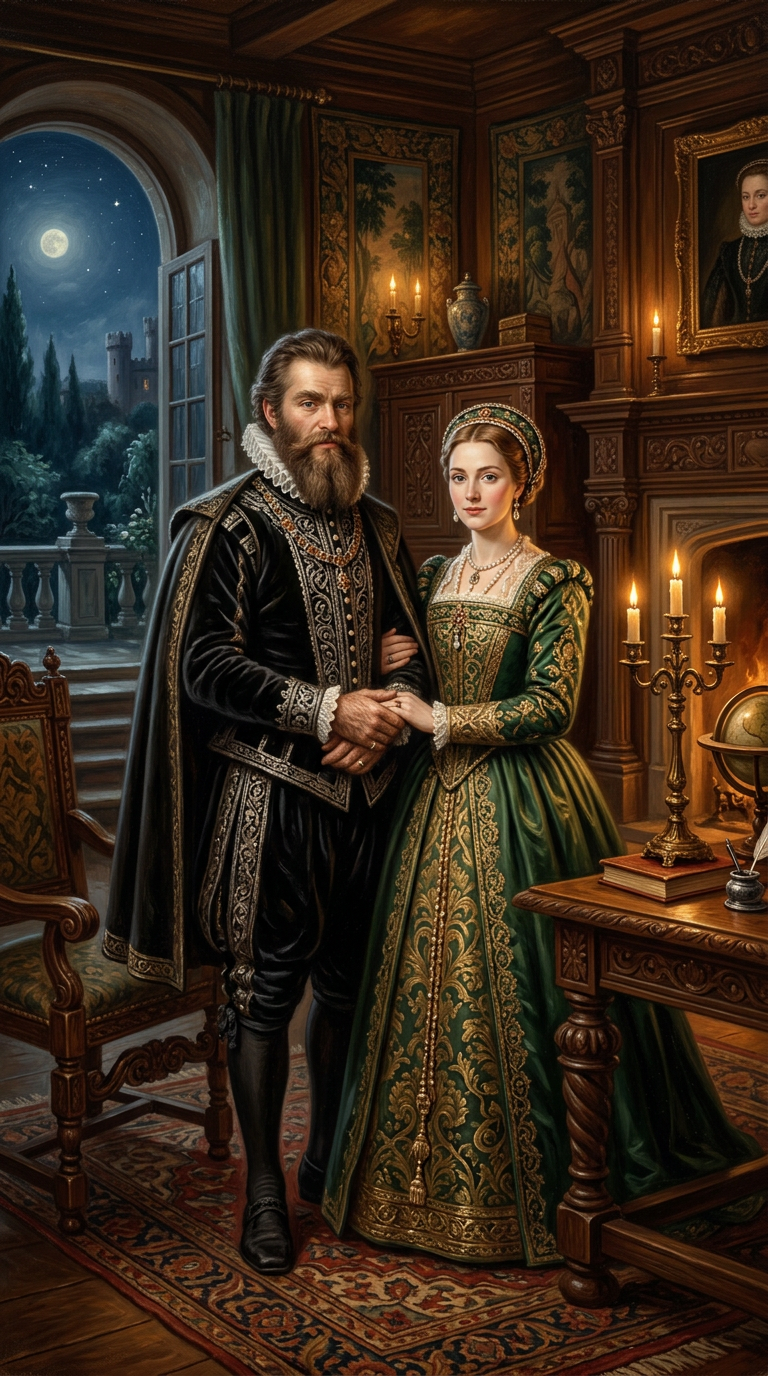
The Beast of the Baroque: The True Story of Petrus Gonsalvus and Catherine
The "Tale as Old as Time" is often treated as a pure work of French fiction, a moral lesson about looking past the surface to find the heart within. But beneath the yellow ballroom gowns and talking furniture lies a historical reality far more haunting.
The real Beauty and the Beast was not a fairy tale; it was a high-society experiment in "civilizing" the wild. It is a story of Hypertrichosis, courtly politics, and a woman who was forced to see the man behind the fur in a world that treated him as a monster.
The "Wild Man" of Tenerife: Petrus Gonsalvus
The "Beast" of history was a man named Petrus Gonsalvus, born in 1537 in the Canary Islands. Petrus was born with a rare genetic condition now known as Hypertrichosis (or "Werewolf Syndrome"), which caused his entire body and face to be covered in thick, dark hair.
At the age of ten, Petrus was captured and brought to the court of King Henri II of France as a "gift." In the 16th century, people with physical anomalies were often kept as "curiosities" or "human pets" in royal menageries.
The Experiment of the King
Henri II, however, had a different plan. He wanted to see if a "wild man" could be "civilized." He gave Petrus a noble education, taught him Latin, and dressed him in the finest robes of the French court. Petrus became a scholar and a diplomat, proving that his "beastly" exterior had nothing to do with his intellectual or spiritual capacity.
The Queen’s "Beauty": Catherine’s Forced Choice
After Henri II died, his widow, Catherine de' Medici, took control of the experiment. She wanted to see what kind of children a "wild man" would produce. She handpicked a beautiful young woman—also named Catherine, the daughter of a court servant—to be Petrus’s bride.
Historical accounts suggest the young Catherine was not told who she was marrying until she reached the altar. Like many women in your GEDCOM files who were married off for political or social "procedures," Catherine’s agency was stripped away. She was expected to be the "Beauty" to the court's "Beast" for the sake of royal curiosity.
The Tragedy of the "Beastly" Lineage
Contrary to the Disney ending, the real story does not end with the Beast transforming into a handsome prince. Petrus remained hairy his entire life, but he and Catherine eventually found a deep, genuine bond. They had seven children together.
The Heartbreak
Four of their children inherited Petrus's Hypertrichosis. Instead of being allowed to live as a family, Catherine de' Medici "gifted" these children to other European royals. They were treated as high-value commodities, taken from their parents, and sent to courts in Spain and Italy to be used as living decorations.
Petrus and Catherine were eventually exiled to Italy, where they lived out their lives in relative obscurity, still under the watchful, "scientific" eyes of the local nobility.
Soul Blueprints: The Archetype of the Outsider
In the realm of Soul Blueprints, the story of Petrus Gonsalvus represents the Exile and the Alchemist. Petrus was tasked with a profound soul mission: to maintain his humanity while being treated as an object.
The Mirror Archetype: The story reflects the "Ice Wall" of societal perception. The court could not see the scholar because they were blinded by the fur.
The "Beauty" Frequency: Catherine represents the soul that must descend into a "frightening" reality to discover the universal truth that form does not dictate essence.
This story is a powerful reminder that "monstrosity" is often a label used by the "civilized" to justify the control and erasure of those who are different.
Connecting to Your Ancestry: The "Different" Ones
When you look at your own family history, you might find ancestors who were "hidden" or "unmade" because they didn't fit the physical or social mold of their time.
The Medical "Procedure": Just as the queens of Tartaria were unmade by the convent, Petrus and his children were unmade by the "scientific menagerie" of the royals.
The DNA Blueprint: We carry the traits, the anomalies, and the "beastly" strength of those who survived being treated as curiosities. Reclaiming their stories is part of our Ancestral Sovereignty.
In your own lineage, there is often a "Catherine"—a woman who found herself in a situation she didn't choose but navigated with a grace that transformed her environment. When we find these women in our GEDCOMs, we aren't just finding names; we are finding the "Beauty" that looked past the "Beast" of circumstance.
Sources and References
"The Marvelous Hairy Girls: The Gonsalvus Sisters and their Worlds" by Merry Wiesner-Hanks.
The Ulisse Aldrovandi Archives: Naturalist records from the 16th century.
The Ambras Castle Collection: Where historical portraits of the Gonsalvus family are preserved.
"The Real Beauty and the Beast" (Historical research on the Medici experiments).
Beauty is the Truth
The real "Beauty and the Beast" is a story of survival. It’s a story of a woman who chose to love a man the world called a monster, and a man who refused to let his fur define his soul. In 2026, as we tear down the "Ice Walls" of our history, we honor Petrus and Catherine—not as a fairy tale, but as ancestors of the human spirit who proved that sovereignty is found within.