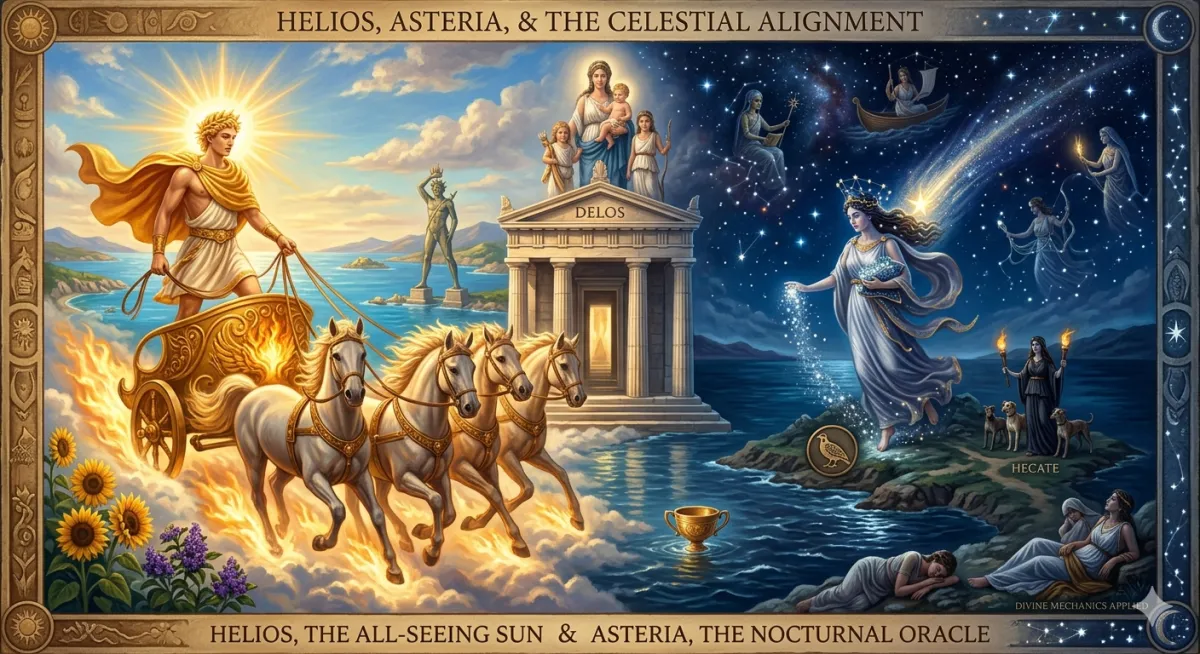
Asteria and Helios: The Cosmic Dance of Night and Day
While Helios and Asteria represent opposing celestial domains—Day and Night—their mythologies are deeply intertwined, creating a powerful, dynamic cosmic balance. Understanding how these two Titans relate to each other provides a more complete picture of the ancient Greek celestial world and its profound spiritual significance.
I. Opposing Forces, Shared Purpose
In the Greek cosmological structure, Helios and Asteria maintain the essential rhythm of existence. They are the definition of Cosmic Duality:
Helios (The Visible Sun): Represents illumination, truth, active energy, the present moment, and the outward, visible journey. He is the standard of time and the public, all-seeing eye.
Asteria (The Hidden Stars): Represents intuition, dreams, potential, the past, the inward journey, and the subtle, internal transmissions. She is the keeper of secrets and the nocturnal, intuitive eye.
Their relationship is not adversarial; it is complementary. Without Helios, the world would remain in eternal, sterile darkness. Without Asteria, the day would never end, leading to burnout and a complete loss of intuitive connection. Together, they provide the necessary contrast for life to flourish, allowing for periods of activity and reflection.
II. Asteria and Helios: Interwoven Myths
The connection between the Sun and the Stars is explored directly through specific myths, particularly those involving Asteria’s flight and transformation.
The Anchoring of Delos: The Birthplace of the Twins
The most critical nexus of Helios and Asteria is the Island of Delos. As explored in the main guide, Asteria transformed into a floating, wandering island (Ortygia) to escape Zeus. This floating sanctuary became the only place where her sister, Leto, could give birth, due to Hera’s curse forbidding Leto from bearing children on "fixed land."
The birth of Leto’s children, Apollo (the Sun) and Artemis (the Moon), is where the paths of Helios and Asteria physically cross:
Providing the Sanctuary: Asteria (as the wandering island) offered the sacred space.
The Divine Transformation: At the moment Apollo was born, four great pillars rose from the seabed to anchor the floating island forever.
Renaming the Island: In honor of the "light" (Apollo) that was now manifest, the island was renamed Delos, "The Manifest" or "The Clear."
This means that Asteria sacrificed her divine form and her freedom to become the physical foundation for the primary Olympian solar and lunar gods. Her "nocturnal, unseen" energy physically grounded the new era of divine light. This myth demonstrates that intuitive wisdom (Asteria) must often be anchored to create a sustainable platform for manifest light (Apollo).
The Relationship Between the Charioteer and the Oracle
A less overt but equally powerful dynamic exists between Helios’s "all-seeing" nature and Asteria’s "nocturnal, intuitive" visions.
Helios: Sees everything that is happening publicly under the sun. He is the guardian of physical truth. Swearing an oath to Helios is binding because he witnesses the external action.
Asteria: Receives transmissions about what has happened, will happen, or is potentially happening in the hidden realm of potential. She is the guardian of spiritual truth. Swearing an oath to Asteria (often through dream rituals or in Gnostic contexts) is binding because she witnesses the internal intent.
This establishes Asteria as the hidden oracle of potential that Helios, from his high chariot, might observe but not fully process. She is the subconscious to his conscious. He sees the public ritual, while she receives the silent intention behind it.
Hecate and the Star-Path: Asteria’s Cosmic Descendants
The deep connection between Helios and Asteria is also evident in the power inherited by their children.
Asteria’s primary legacy is Hecate, the goddess of witchcraft and the "Star-Path." It is essential to remember that Asteria is the mother of magic, but Helios is the father of Hecate’s most famous lineage.
Hecate's direct descendants are the powerful sorcerers Circe and Medea, who are the daughters/granddaughters of Helios and Perse.
This creates an extraordinary, powerful witch-path lineage:
Hecate: Inherits the connection to the stars and the night (from Asteria) and the connection to transformation and gateways.
Circe & Medea: Inherits the connection to potent, fire-based magic and the "all-seeing" ability to understand the composition of things (from Helios) and magic itself (from Perse).
This means that in the world of Greek magic, Asteria provides the celestial blueprint (the stars), while Helios and Perse provide the material potency (the herbs and the fire). Together, they are the complete magical toolkit.
Cross-Pantheon Connections: Night and Day Beyond Greece
This dynamic of the Sun and Stars—the Visible vs. the Hidden—is mirrored in various global pantheons:
Egypt: Ra (The Sun) and Nut (The Night Sky): While not siblings, Nut’s vast, star-covered body arches over Ra’s solar boat, providing the arena for his daily journey. She swallows him at night, allowing him to travel through the Underworld (Tuat), mirroring Helios’s nightly passage in the golden cup. Asteria’s role is more specialized, resembling Seshat (the stellar record-keeper), but the structure remains.
India: Surya (The Sun) and The Nakshatras (The Starry Mansions): Surya is the primary solar deity, but Indian astrology relies profoundly on the 27 Nakshatras (star constellations), which govern different aspects of fate and intuition. Asteria is the perfect archetype for the intelligence behind these starry "mansions" and the wisdom they hold.
Gnosticism: The Logos (Light/Word) and Sophia (Starry Wisdom): In Gnostic thought, the Logos is the primary source of light and truth. Sophia (Wisdom) is the divine feminine aspect whose "fall" into matter provided the "sparks" (souls) that the light seeks to redeem. This perfectly mirrors the dynamic of the stable sun (Helios) and the wandering star (Asteria) who grounds itself to help light manifest.
Synthesis: Asteria and Helios as a Combined Archetype
When exploring Asteria Rising, integrating Helios is not just about showing a contrast; it is about showing a complete Spiritual Ecosystem.
For Astrology: Helios is the Sun sign (the outward identity), while Asteria is the complex, internal blueprint of the entire birth chart.
For Oracle Work: Helios provides the visible, external answer, while Asteria provides the deep, underlying intuition and dream guidance.
For Daily Practice: Helios is the outward work and manifestation, while Asteria is the inward introspection, dream work, and grounding rituals that sustain that manifestation.