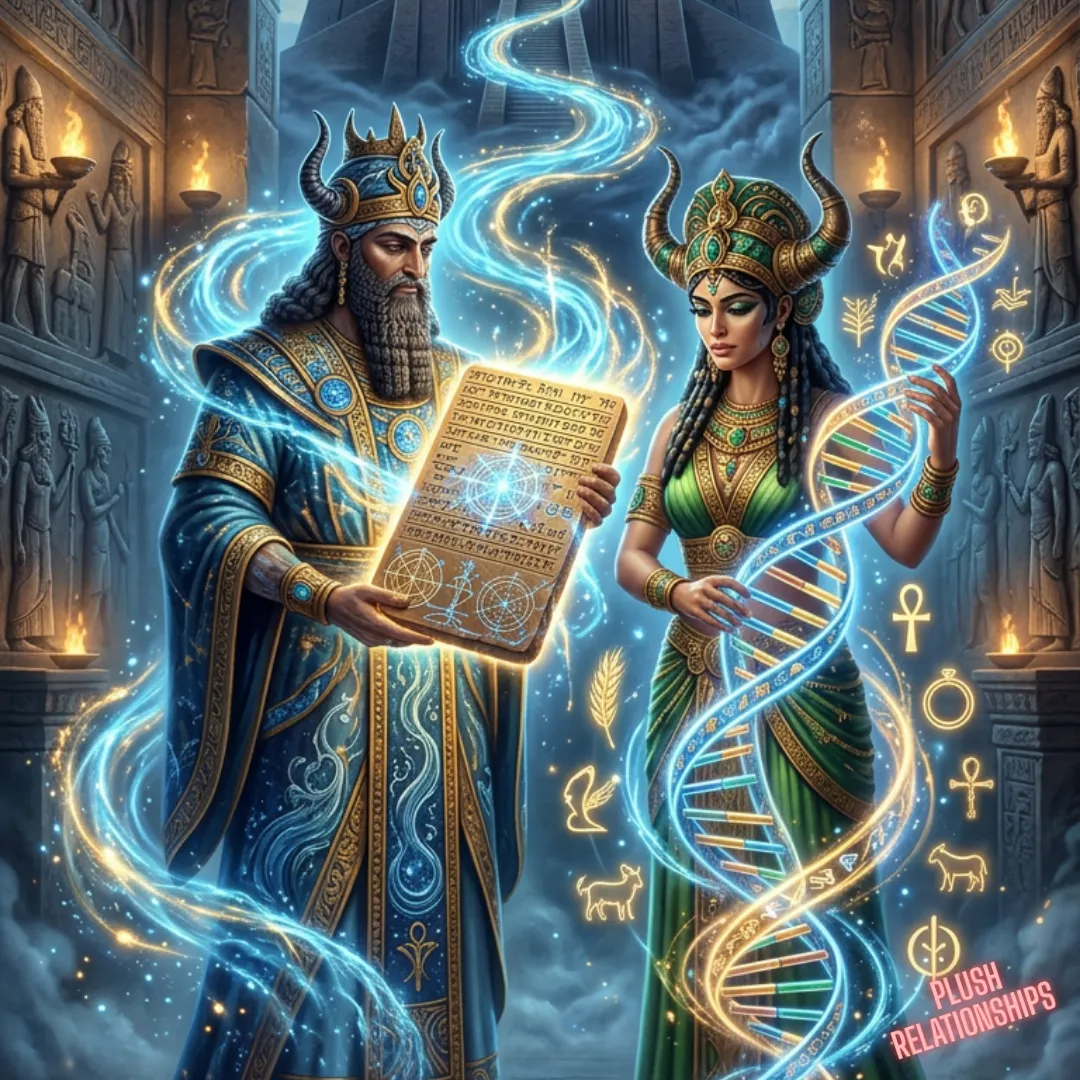
The Divine Laboratory: The Sacred Partnership of Enki and Ninhursag
In our pursuit of the "unknown but true facts of life," we often view the Anunnaki as solitary figures. However, the most profound shift in human history—the creation of our "princely seed"—was the result of a complex, often turbulent, but ultimately productive partnership between Enki, the Master Constructor, and Ninhursag, the Mother of Life.
Together, they represent the union of Intellect (The Con) and Manifestation (The Mother). Their relationship is the ultimate "Divine Laboratory," where the blueprints of our modern DNA and spiritual archetypes were first drafted.
A Partnership of Necessity and Genius
The relationship between Enki and Ninhursag was not a traditional "marriage" in the modern sense; it was a high-level collaboration between two specialists. While Enki held the Me—the digital-like codes of civilization—Ninhursag held the mastery over the biological "clay".
Complementary Forces: Enki provided the vision and technical "spark," while Ninhursag provided the physical framework and the nurturing environment required for life to take hold.
Co-Creators of the Lulu: Their greatest joint venture was the creation of humanity. In ancient texts, they work side-by-side, experimenting with different "blueprints" until they achieved a stable, conscious being.
The Midwife and the Scientist: Ninhursag is often described as the "midwife" to Enki’s ideas, bringing his abstract concepts into the tangible world.
The Myth of Dilmun: Conflict and Consequence
Like any powerful partnership, Enki and Ninhursag faced significant friction. Their myths serve as allegories for the struggle to balance scientific progress with natural law.
In the paradise of Dilmun, Enki consumed eight sacred plants that Ninhursag had carefully cultivated. Furious at this violation of the natural order, Ninhursag withdrew her "life-giving" energy and cursed Enki. He fell deathly ill, with eight of his organs failing simultaneously. It was only through the intervention of the other gods that Ninhursag was persuaded to return and heal him.
Expanding the Eight Deities of Healing
To save Enki, Ninhursag placed him in her womb and gave birth to eight specific deities, each born to heal a corresponding failing organ in Enki's body. These deities represent more than just ancient myth; they represent the restoration of the "Soul Blueprint" across various life domains.
Abu (The Plant God): Born to heal Enki's skull. This relates to the crown chakra and our connection to higher wisdom (The Oracle's Desk).
Ninsitul: Born to heal his hair. In genealogy, hair represents our crowning lineage and the preservation of ancestral memory.
Ninsutu: Born to heal his nose/respiratory system. This signifies the "breath of life" and the 1st House of self-expression in an astrological chart.
Ninkasi: Born to heal his mouth. As the goddess of beer and nourishment, she represents the 2nd House of resources and what we consume to sustain our "princely seed".
Nanishe: Born to heal his throat. This is the center of communication and the marketing professional’s power to decree truth into the world.
Azimua: Born to heal his arms. This represents the 3rd House of siblings and local community, reflecting how we "reach out" to build our digital and physical networks.
Ninti (The Lady of the Rib): Born to heal Enki’s rib. This is a pivotal genealogical marker; the Sumerian word Ti means both "rib" and "to make live." This is the origin of the "Eve" archetype and the birth of the feminine sovereign line.
Enshag: Born to heal his limbs/feet. This corresponds to the 12th House of the subconscious and our foundations, ensuring we are "grounded" as we walk the path of the seeker.
The "Cons" of the Anunnaki Triad
Within your research framework, Enki and Ninhursag represent the two halves of the "Cons" (Constructors and Consorts).
Enki as the Designer: He is the one who designs the intellectual frequency within us—our capacity for innovation and logic.
Ninhursag as the Builder: She is the one who constructs the physical vessel and the ancestral lineage that allows that frequency to manifest.
The Shared Legacy: When you trace family history back through marriage registers or church records, you are looking at the combined work of these two ancestors—spirit and flesh woven together.
Sources
Wikipedia: Enki and Ninhursag (The Myth of Dilmun)
World History Encyclopedia: The Sumerian Creation Myths
The Oracle's Desk: Personal Research on Anunnaki Archetypes and Genealogy