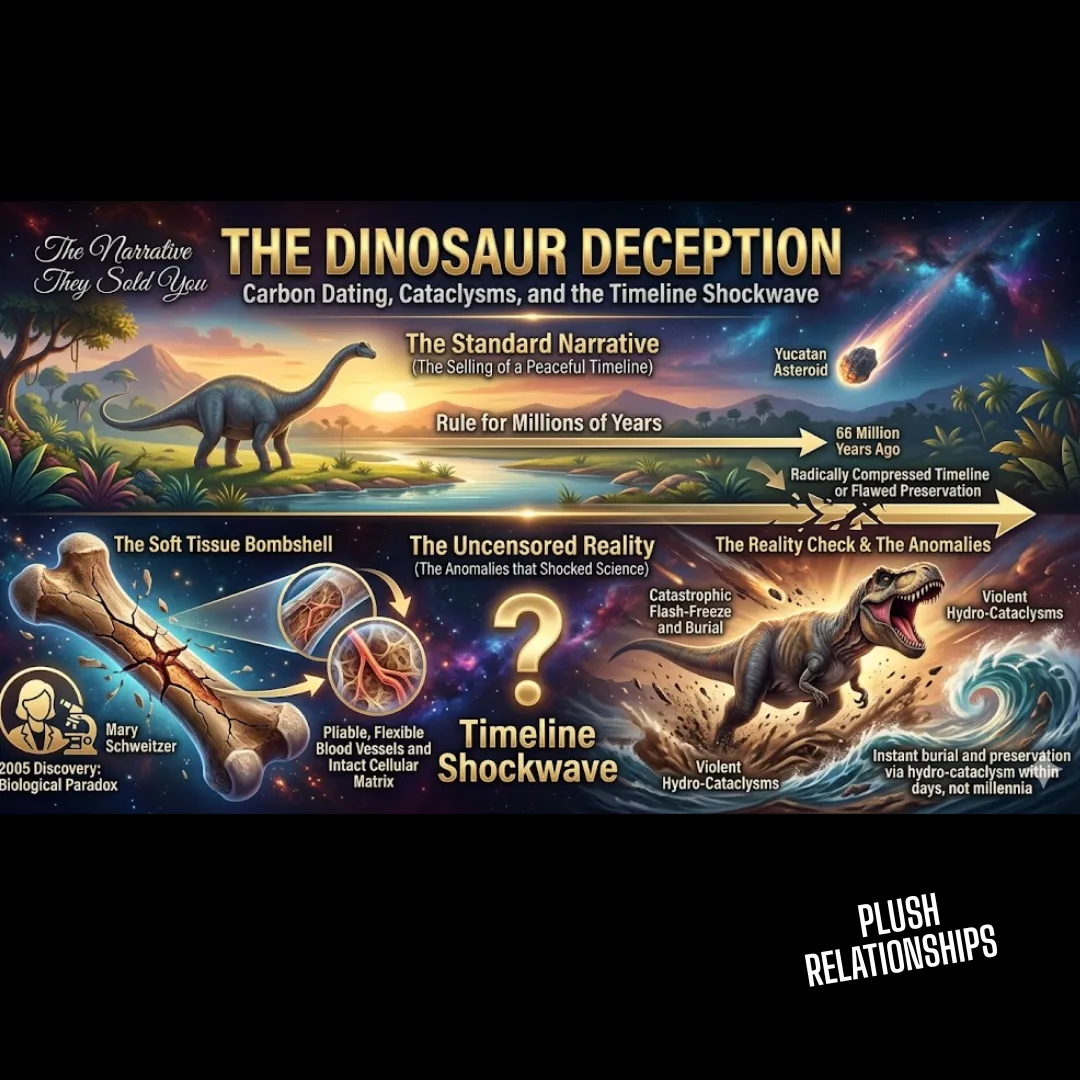
The Dinosaur Deception: Carbon Dating, Cataclysms, and the Timeline Shockwave
What if everything you were taught about the age of dinosaurs is completely wrong—and science already has the proof?
We have all been sold a very specific, cinematic story. The narrative claims that dinosaurs ruled the Earth in a slow, peaceful, millions-of-years vacuum until a single, isolated asteroid hit the Yucatan Peninsula 66 million years ago. According to this textbook tale, the dinosaurs were instantly frozen in time, buried in neat, perfect, linear layers of dirt like a pristine historical filing cabinet.
But when you actually dig into the modern fossil record, that clean, linear timeline begins to fracture. The real data reveals a history marked by volatile planetary resets, impossible organic discoveries, and deep-time dating methods that are far more speculative than the textbooks care to admit.
The Soft Tissue Bombshell
In 2005, a groundbreaking discovery shook the foundations of paleontology. Scientist Mary Schweitzer published findings that sent shockwaves through the scientific community: inside a fractured Tyrannosaurus rex femur, she discovered flexible, intact blood vessels, transparent cells, and pliable soft tissue.
According to fundamental biochemical laws, cellular proteins and organic matrices should completely degrade into dust within a few million years at absolute most. Yet, here was organic, bendable tissue.
The Big Question: If these bones have been sitting in the ground for 66 million years, how is there still flexible biological tissue inside them?
This anomaly leaves us with two inescapable conclusions: either our understanding of biochemical preservation is fundamentally flawed, or the planetary timeline is radically more compressed than we’ve been led to believe.
The Illusion of Perfect Dating
When a textbook says a dinosaur fossil is exactly 75 million years old, the average reader assumes a scientist ran a test directly on the bone. In reality, you cannot carbon-date dinosaur bones to get millions of years. Carbon dating is only accurate up to roughly 50,000 years.
Instead, scientists use radiometric dating (like Potassium-Argon) on the layers of volcanic rock found above and below where the fossil was dug up.
This method relies on a massive assumption: a closed system. It assumes that for tens of millions of years, no groundwater seeped through the stone, no seismic pressure altered the chemical compounds, and no intense energetic shifts shifted the mineral ratios.
In the real world, the Earth is alive and volatile. Interstellar radiation, massive floods, and tectonic shifts constantly alter these delicate chemical ratios, making deep-time dating a highly speculative estimate rather than an exact mathematical fact.
Flash-Frozen: The Reality of Planetary Resets
The narrative of "uniformitarianism"—the belief that the Earth’s geology changes only through slow, gradual dripping over millions of years—is being actively debunked by the physical evidence of cataclysms.
Fossilization itself is an anomaly. If an animal dies naturally today, scavengers scatter the bones and elements rot them away within weeks. To get a perfectly preserved fossil, the animal must be buried instantly under immense pressure, cutting off all oxygen.
The physical layout of major fossil beds looks less like a peaceful graveyard and more like a mass-casualty event caused by sudden, violent hydro-cataclysms. Entire ecosystems were flash-buried under millions of tons of churning sediment within days, not millennia.
We see proof of these sudden, violent resets all over Earth's recent history—such as the Younger Dryas cataclysm roughly 12,800 years ago, where sudden impacts and massive floodwaters completely reshaped the globe overnight. The Earth doesn't change by slow dripping; it changes in violent, evolutionary leaps and bounds.
Core Fact Check: Truth and Clarity
Fact:
Flexible, elastic soft tissue and intact blood vessels were recovered from a T-Rex bone, defying standard laws of long-term protein decay.
Fact:
Radiometric dating does not test the fossil itself, but the surrounding volcanic rock, which is highly susceptible to environmental contamination over time.
Fact:
Fossilization requires immediate, high-pressure burial, proving that fossil beds are the result of sudden catastrophic events rather than slow, gradual accumulation.
The history of our planet isn't a long, boring, linear line. It is a thrilling, volatile story of a resilient world that has undergone rapid, dramatic resets. Once we strip away the rigid textbook dogmas, we find a reality that is far more dynamic than we ever imagined.