The Uncensored History of the Cosmos: The Big Bang Anomalies and the Cosmic Lattice
What if the biggest explosion in history never actually happened?
The standard textbook narrative of the universe's origin is facing a quiet but profound crisis. For decades, the public has been taught that roughly 13.8 billion years ago, everything in existence was compressed into an infinitely dense, microscopic point called a singularity. Then, for reasons physics cannot explain, it exploded.
According to this classical model, this chaotic blast eventually organized itself into perfect mathematical laws, predictable orbits, and conscious life.
However, data from advanced space telescopes and deep-space radiation mapping have revealed significant structural anomalies. These findings do not fit the traditional model of a random, chaotic explosion, forcing astrophysicists to re-examine the foundational assumptions of modern cosmology.
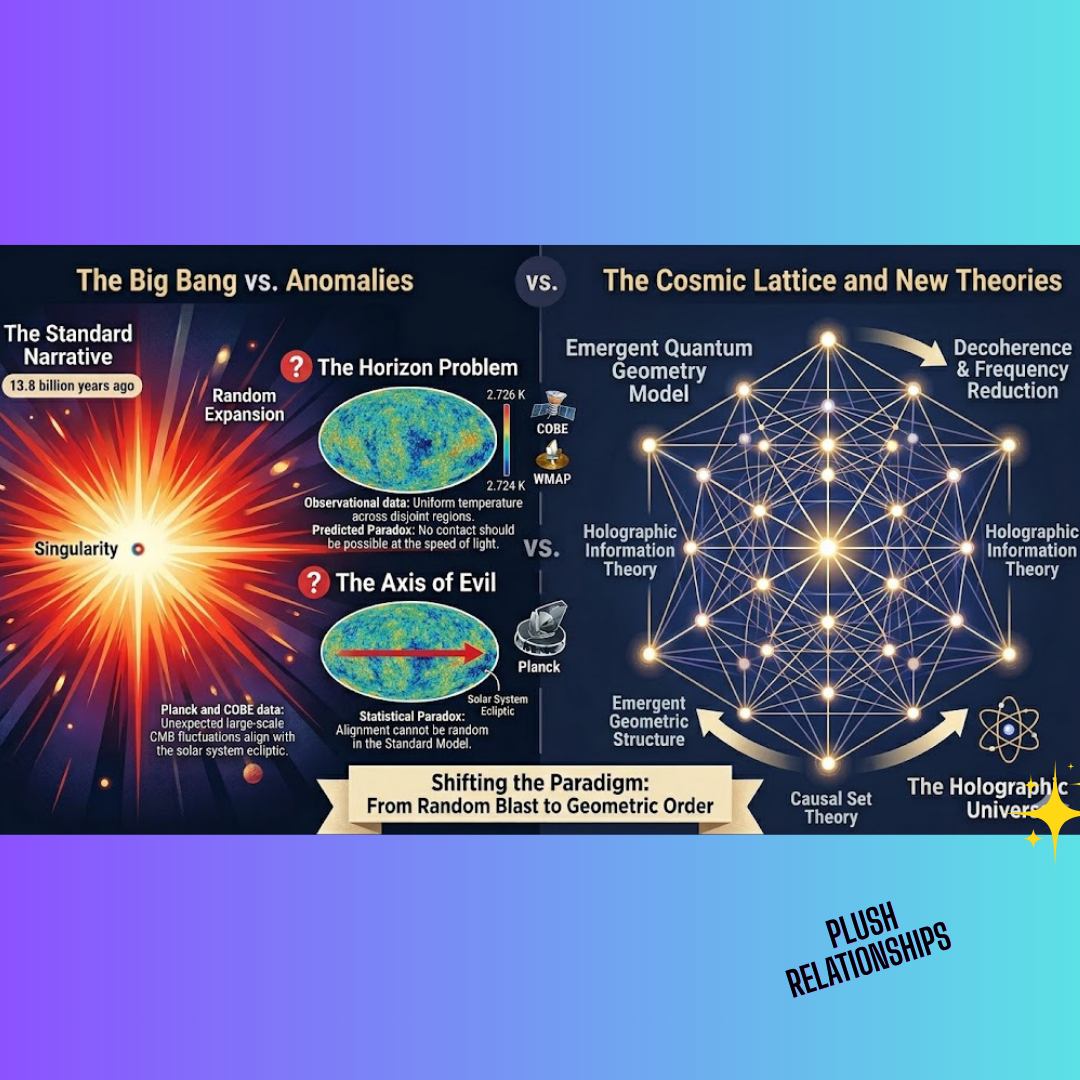
The Horizon Problem: Impossible Uniformity
One of the most persistent challenges to the standard Big Bang model is the Horizon Problem.
When astrophysicists map the Cosmic Microwave Background (CMB)—the leftover thermal radiation from the early universe—they observe a nearly flawless uniformity. The temperature of deep space is approximately 2.725 Kelvin everywhere, varying by only one part in 100,000 across opposite sides of the visible sky.
In a standard expanding explosion, different regions of space would have expanded too quickly to interact or exchange heat. Because nothing travels faster than the speed of light, Region A and Region B (separated by billions of light-years) could never have been in thermal contact.
The Paradox: How did two entirely disconnected regions of the universe achieve identical temperatures without ever exchanging energy?
To save the standard model, cosmologists introduced the Inflation Theory, which posits that a fraction of a second after the Big Bang, the universe expanded exponentially faster than light. While inflation remains the dominant mathematical patch, it requires highly specific, unobserved initial conditions and an unknown energy field (the "inflaton") to work, leaving the underlying cause of this synchronized uniformity open to debate.
The "Axis of Evil": Non-Random Alignments
In a truly random, isotropic universe (one that looks the same in all directions), the fluctuations in the CMB should be scattered completely at random. However, detailed data from the WMAP and Planck satellites revealed a striking, non-random alignment.
Physicists discovered that the largest thermal fluctuations in the CMB are aligned along a massive, preferred axis in space. Strikingly, this axis aligns closely with the ecliptic plane—the orbital path of the planets in our own solar system.
This alignment is mathematically highly improbable in a standard expanding universe. Because it threatens to undermine the Cosmological Principle—the foundational assumption that the universe is uniform and features no special directions or locations—astrophysicists quietly dubbed this alignment the "Axis of Evil."
If these alignments are truly cosmic and not an artifact of local contamination or observational error, it suggests that the large-scale structure of the cosmos is tied to a specific geometric orientation.
3. The Shift Toward Cosmic Geometry and Quantum Resonance
As the "random explosion" narrative faces empirical friction, theoretical physicists are increasingly looking at alternatives rooted in information theory, quantum mechanics, and cosmic geometry.
The Holographic Principle
Derived from string theory and black hole thermodynamics, the Holographic Principle suggests that our three-dimensional universe can be mathematically described as an information structure encoded onto a distant, two-dimensional boundary. Instead of a chaotic blast of matter, space-time itself may emerge from quantum entanglement.
The Cosmic Lattice and Wave-Particle Duality
At the quantum scale, matter does not behave like solid, isolated billiard balls; it behaves like localized excitations within underlying quantum fields. When viewed through this lens, the creation of matter is not an explosive mechanical event, but rather a process of phase transition or quantum resonance.
Just as water vapor cools and condenses into a highly structured geometric ice lattice, theoretical frameworks suggest the early universe may have undergone a geometric transition. Energy did not blast outward through space; instead, space itself underwent a structured drop in energy density, freezing field potentials into the dense, physical matter we observe today.
Core Fact Check: What the Data Confirms
Fact: The Cosmic Microwave Background is exceptionally uniform, a reality that standard explosive expansion cannot easily explain without invoking unproven inflationary mechanisms.
Fact: The "Axis of Evil" is a verified statistical anomaly in the CMB data across multiple satellite missions, showing a directional alignment that violates standard randomness.
Fact: Space is not empty; it is governed by underlying quantum fields that dictate the behavior and geometry of all observable matter.
The data demonstrates that the universe is far more interconnected, geometrically structured, and mathematically synchronized than a simple, chaotic explosion would allow. As data accumulates, cosmology continues to shift away from the concept of a random accident and toward a deeply integrated, highly organized geometric matrix.